


A Gift or Seven
Bhutan Baccalaureate Learning Process
Druk Gyalpo’s Institute
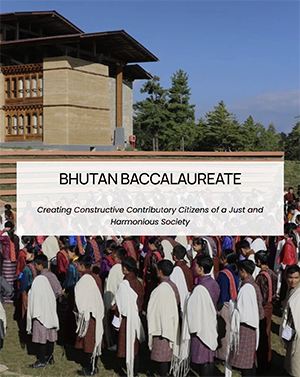
Bhutan’s Gross National Happiness index is well known as a more holistic alternative to GDP, incorporating factors beyond wealth to assess the country’s progress and to inform policy. It is therefore interesting to encounter an educational framework from the same kingdom that takes a similarly holistic view of human development. The Bhutan Baccalaureate, which begins with early childhood and extends through Grade 12, is a reform effort being implemented in Bhutanese schools. The Baccalaureate identifies five interconnected areas of development: social, emotional, physical, spiritual and cerebral. The Baccalaureate takes a familiar early-childhood practice — show-and-tell — and develops it into something much more substantial through its “Seven Gifts.” Learners bring cultural artifacts and experiences to school, including songs, patterns, and languages. The Gifts position community as a source of knowledge and invite learners to connect what they encounter at home with what happens at school. Show-and-tell therefore becomes a way to recognize, preserve, and build on the knowledge learners bring with them. The framework also offers educators some provocative alternatives to familiar ideas about what schools are for. While many independent schools include growing leaders in their missions, the Baccalaureate emphasizes developing a “Person of Substance.” The Baccalaureate's Attributes of School Excellence also invite a more fundamental question: What might your school look like through a framework that emphasizes, among other things, nurturing individualism, cultivating purpose, and finding joy in learning?
