


Access to Challenging Work
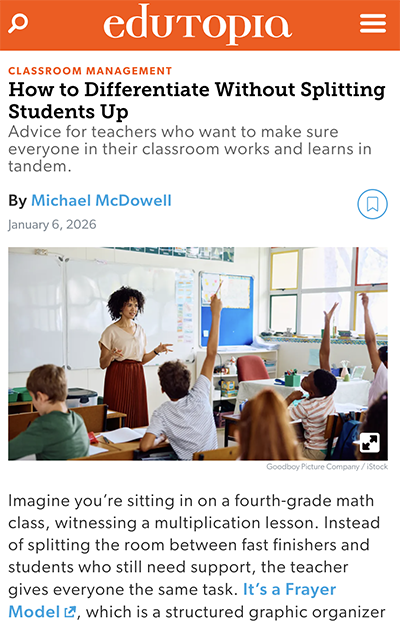
How to Differentiate Without Splitting Students Up by Michael McDowell
Edutopia, January 6, 2026
Independent schools champion both academic rigor and individualized learning. However, too often, we treat these commitments as competing priorities. What if the challenge is not choosing between them but rethinking how we deliver both? Michael McDowell’s “How to Differentiate Without Splitting Students Up” challenges the notion that differentiation requires dividing students by ability. He offers practical strategies that invite students to engage in shared intellectual work through accessible entry points and purposeful questioning. In mathematics, for example, students can approach the same problem with vastly different levels of confidence and preparation. Regardless, difference should not determine who gets access to challenging work. McDowell’s approach reminds us that rigor is not measured by how difficult we make learning to access, but by the quality of thinking we ask students to do. For independent schools, this conversation extends beyond individual classrooms. As students evolve, so must our curriculum, professional learning, and instructional practices. The question, then, becomes whether we are willing to rethink the structures that have traditionally defined rigor, instead of whether we can maintain high expectations while differentiating.
