


Because It Is Difficult
What Do Students Lose When They Stop Writing? by Dana Goldstein
The New York Times, August 17, 2026
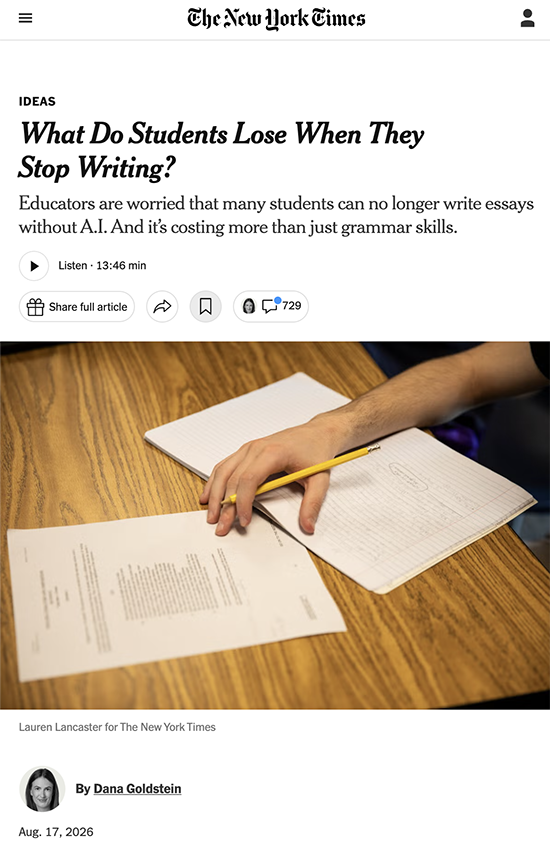
Surveys suggest that between two-thirds and 90 percent of high school and college students already use AI for schoolwork. Meanwhile, technology companies market writing assistants to schools as essential job preparation. But what happens to student thinking when the hardest part of writing disappears? In “What Do Students Lose When They Stop Writing?” education reporter Dana Goldstein argues that composing an essay without help is valuable because it is difficult. Goldstein draws upon research linking writing to working memory, planning, and metacognition, in general, and to the work of psychologist Ronald Kellogg, in particular. Indeed, Kellogg found that drafting a persuasive essay is as mentally taxing as digging a ditch is physically. Additionally, a small MIT study found that writers who worked with chatbots showed lower brain activity and struggled to remember what they had written. Even the study modes that Google and OpenAI market as writing guides produced polished paragraphs once Goldstein asked for an example. For independent and international school leaders drafting AI policy, Goldstein’s account of the University of Sydney’s two-lane approach is a concrete starting point. Rather than choosing between a ban and full adoption, a school can decide which assessments students must write alone, and where AI may support feedback and revision.
