


Decline, Offloading, and (Now) Stunting
Is It Time to Measure Cognitive Stunting? by Rebecca Winthrop
Brookings Institution, May 29, 2026
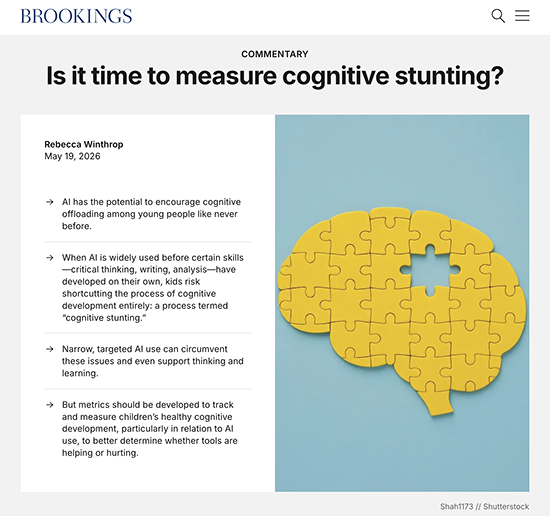
Many educators sense that generative AI poses risks to students' intellectual development but struggle to articulate precisely how. While leading the Brookings Global Task Force on AI and Education, Rebecca Winthrop encountered this challenge firsthand. Her research led her to propose the term cognitive stunting to describe the potential consequences for students' intellectual development. Unlike cognitive decline, which involves the deterioration of existing abilities, cognitive stunting occurs when students fail to develop those abilities in the first place because they bypass the intellectual work necessary to acquire them. Winthrop also distinguishes cognitive stunting from cognitive offloading, the use of external tools to reduce mental effort. While she acknowledges that offloading is neither new nor inherently harmful, she points out that generative AI now allows students to delegate tasks essential to learning, including generating ideas and constructing arguments. By bypassing the practice, struggle, and reflection necessary to develop these abilities, students risk stunting their growth. As she observes, “Cognitive development, like learning to ride a bike, cannot be outsourced.” The concern is therefore not simply what students offload, but when and why. Early research raises similar concerns. Winthrop cites studies linking AI reliance to weaker critical thinking and reduced neural engagement during writing. Although these findings do not establish lasting developmental harm, they underscore the need for systematic measurement.
