


Get Lost
“What Constant Surveillance is Doing to Children (and their parents)” by Sarah Zhang
The Atlantic, November 9, 2026
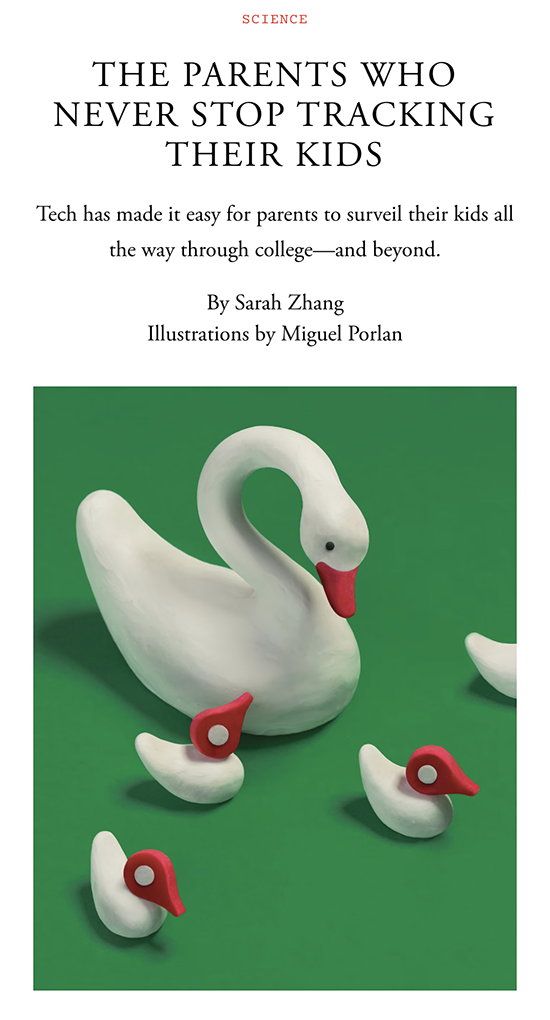
Some of the most well-known stories depend on a formerly universal human experience, that of getting lost. Hansel and Gretel, Alice in Wonderland, Chihiro in Spirited Away – how would any of these children have learned any of the vital things they learned without first escaping the watchful eye of their respective parents? In today’s frictionless, digital world, however, the chances of getting lost are only as great as the loss of a smartphone. Tracking devices and apps such as smartwatches, AirTag, and Life360 have taken such a firm hold that many parents now experience a near-constant need to know the whereabouts of their children, “the geo-located generation,” according to Sarah Zhang of The Atlantic. In her article, “What Constant Surveillance is Doing to Children (and their parents),” Zhang describes a “technological panopticon” that begins at birth with bassinets that track a baby’s sleep patterns and continues steadily through baby’s experience at school, camp, college, and, ultimately, adulthood. The long-term effects of this “digital tethering” are as yet unknown, but signs are not good: child-tracking devices do not make kids much safer than they would otherwise be, yet research shows that they do make children more risk-averse and dependent. For example, “teenagers today are less likely to get a job, go on a date, or drive,” writes Zhang. And it isn’t just children and teenagers whose lives are being changed by their constant surveillance – parents, too, are at risk of failing to thrive as they transition from a full to an empty nest while monitoring their children's locations. Zhang’s article is helpful for educators who work every day with children who find it increasingly difficult to get or be lost, conditions that are important to both identity formation and deep learning.
