


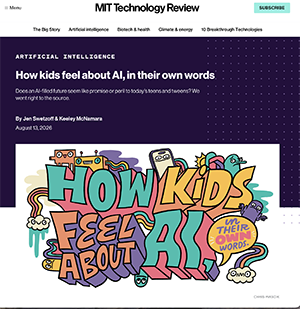
Never My Doctor
“How Kids Feel About AI in Their Own Words” as told to Jen Swetzoff and Keeley McNamara
MIT Technology Review Vol. 129 No. 5 September/October 2026
Adults everywhere are talking about AI – what it is, how it’s used, and what its impact on school, life, and society may be in the near and not-far future – but what do kids themselves think about the phenomenon? To find out, Jen Swetzoff and Keeley McNamara, founding editors of Anyway magazine for tweens and teens, asked them. Unsurprisingly to educators who work with them on a daily basis, the students’ opinions on AI were both nuanced and sophisticated. Remy, 16, of New York, chose the word “indifferent” to describe their feelings on the topic. “I teach taekwondo. I read. I play games with friends. None of that needs AI. I mean, I use it (Claude, the free version)… but at school, I actually think AI mostly makes my assignments worse, not better.” Danielle, 18, of California, worries that blind trust in AI will breed misinformation, disinformation, and bias, while Wesley, 14, of Ohio, is concerned that AI will “[rob] us of our ability to think creatively, to think for ourselves.” Evelyn, 13, of Oregon, hopes to be a doctor and sees the benefits of AI tools, but feels strongly that humans, not machines, should provide care to others. “I never want it to be my doctor,” she says. And then there's Krishiv, 17 of Ontario, who believes that the most important competencies for students to develop in the age of AI are “initiative, judgment, and self-direction.” Although there is plenty to keep teachers and school leaders up at night concerning AI, Swetzoff and McNamara's research strongly suggests that the kids are still all right.
