


Of Note: Seemingly Random Flashes
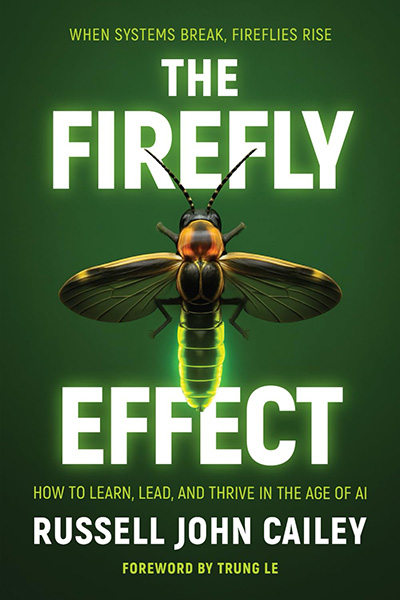
The Firefly Effect by Russell John Cailey
Game Changer Publishing, September 18, 2025
What happens when change moves faster than an institution’s ability to respond? In education, this is no longer a hypothetical question. Rapid technological change, expanded access to information, and AI are challenging fundamental assumptions about what students need to know, how they learn, and how schools prepare them for an uncertain future. In The Firefly Effect, Russell John Cailey challenges educators to reconsider the structures and timelines that shape learning. As AI accelerates knowledge acquisition and task performance, he advocates for regenerative learning cycles that cultivate brilliance rather than reproduce rote, assembly-line models. The firefly offers a compelling metaphor: seemingly random flashes synchronized through a living network without centralized command. Applied to education, this model suggests that innovation can emerge through human connection, distributed agency, and collective intelligence. The challenge is not to abandon strategic planning, but to build institutions capable of continuous adaptation. Schools must pair enduring commitments with flexible practices, shorter cycles of experimentation and reflection, and empower educators to respond to emerging needs. Rather than positioning technology and human intelligence as competing forces, schools should harness their complementary strengths to amplify learning and innovation. Ultimately, a school’s greatest strategic advantage may not be its ability to predict the future, but its capacity to learn, adapt, and regenerate as the future unfolds.
