


Something Ineffable
The Claims of Close Reading by Johanna Winant
Boston Review, November 26, 2025
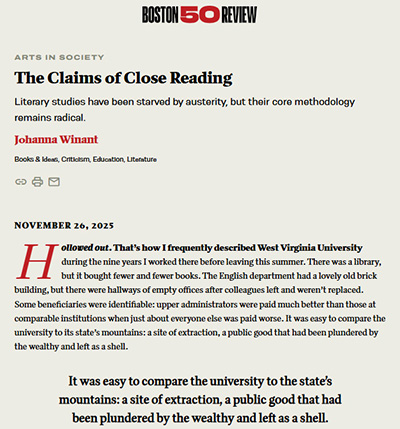
Johanna Winant’s moving ode to close reading is the perfect counterpoint to educators’ feelings of ennui and despair in the current technological and political moment. Winant was an instructor at West Virginia University, one of many institutions “hollowed out” by political and cultural forces. Winant, however, has been heartened by her experience of teaching students the time-tested, labor-intensive, and cognitively challenging task of close reading even in the context of the declining institution. Winant is obviously a skilled, patient teacher, but her commitment to practice and praxis is sure to inspire educators looking for a deeper reflection on why we do what we do. She contextualizes her argument in favor of the pedagogical importance of close reading in a “flurry of books” from the past few years, but she grounds her reflection in her experience working with the wide cross section of students at WVU, “trying to describe how teaching can feel magical” even as she understands the cliche. Part of that magic, as Winant understands, is that teaching means that one is “always learning” from and with one’s students; Winant’s essay is a beautiful encomium to the practice of learning. Winant is candid that writing about teaching is challenging—there’s always something ineffable in the alchemic classroom experience—but Winant’s close reading skills have also made her an incisive writer, and the piece is inspiringly thoughtful about what students learn when they’re taught, and inspired, to close read, to attend and to reflect. Indeed, Winant frames close reading as a practice of sense-making grounded in noticing and good-faith argument. Although Winant reaches for “magic” to describe the transformative power of teaching, she closes by noting that teaching students to close read is a tangible, practical, and necessary skill for the current moment; it is a practice with real power.
