Klingbrief Archive

Vol 138 - January 2026

Book

Of Note: The Power in Learning How to Learn

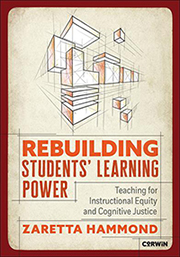
Rebuilding Students' Learning Power by Zaretta Hammond
Corwin, 2025

How do we empower students? In her recent book, Rebuilding Students’ Learning Power, Zaretta Hammond suggests we teach them how to learn. Hammond offers a concise, practice-forward guide for strengthening students’ cognitive resilience. She argues that “learning loss” is an incomplete frame. Instead, students need the opportunity to rebuild the internal capacities that fuel problem-solving, independence, and intellectual confidence. Drawing on neuroscience and culturally responsive pedagogy, Hammond outlines routines that help students stretch working memory, strengthen attention, and develop productive struggle-capacities she calls “learning muscles.” Her recent Cult of Pedagogy conversation with Jennifer Gonzalez reinforces these ideas, highlighting that ownership for their learning emerges when students begin to see themselves as apprentices in the craft of learning rather than passive recipients. For educators, Hammond offers a clear vocabulary and pragmatic structures that shift faculty questions from “How do I plan an engaging activity?” to “How do I coach students to become stronger thinkers?” Her framework also equips professional learning communities and instructional rounds teams with observable indicators of cognitive work. This timely book is an energizing resource for teachers, departments, instructional coaches, and anyone designing learning environments that cultivate student agency and academic belonging.
Submitted by
Nicole Furlonge, Klingenstein Center, Teachers College, Columbia University, New York, NY
Science of Learning
Teaching Practice
Article

Unfit Systems

America’s Children Are Unwell. Are Schools Part of the Problem? by Jia Lynn Yang
New York Times Magazine, November 24, 2025

Educators have likely observed the increase in children's stress and anxiety levels over the last few decades, perhaps especially the last few years. What if schools themselves were responsible for this? In a piece for the New York Times Magazine, Jia Lynn Yang traces how the expectations of childhood have changed and how schools and school systems have evolved to meet these expectations. Throughout the latter half of the 20th century, as politicians and school systems placed ever-increasing value on test scores and other quantitative metrics (with public funding often tied to these metrics), incentives for various mental health diagnoses emerged for both schools and families. If a child “doesn’t fit,” as Yang puts it, or experiences friction within a rigid school environment, a diagnosis can seem like a helpful option, giving access to adaptations or accommodations which can help children meet challenging expectations. Yang does not propose a solution to these problems, though she mentions some parental responses like microschools and the “unschooling” movement. Institutions and educators who believe in the transformative power of education must consider their place in the worrisome culture Yang describes and consider the true impact of the system of expectations we build.

Submitted by
Gregory Sokol, The Roxbury Latin School, West Roxbury, MA
Psychology & Human Development
Student Wellness & Safety
Teaching Practice
Article

To Balance Innovation with Care

Artificial intelligence for personalized learning: a systematic literature review by Glenn Hardaker; Liyana Eliza Glenn, Corresponding Author
International Journal of Information and Learning Technology, January 13, 2025

The integration of artificial intelligence (AI) into personalized learning presents both strategic opportunities and ethical responsibilities for educational leaders. Personalized learning, defined as instruction that optimizes pace and approach to meet individual learner needs, requires leadership that prioritizes responsiveness, equity, and coherence across instructional systems. AI, grounded in computer science and theories of human intelligence, enables schools to move beyond static instructional models by leveraging advanced data analysis to adapt content, assessment, and delivery to learners’ evolving needs. From a leadership perspective, the emergence of AI-supported digital classrooms and learning analytics reshapes how teaching and learning are monitored and managed. Machine learning applications, such as automated assessment, performance prediction, and adaptive feedback, offer efficiencies that can support instructional improvement at scale. However, educational leaders must critically evaluate how these tools influence professional judgment, student autonomy, and instructional quality. While AI can reduce reliance on predefined algorithms and increase responsiveness to learner performance, it also introduces heightened demands for ethical oversight, transparency, and alignment with pedagogical values. Effective educational leadership, therefore, involves stewarding AI integration in ways that balance innovation with care. 

Submitted by
Dr. Zohreh Janinezhad, Hawken School, Gate Mills, OH
Leadership Practice
Teaching Practice
Technology
Article

Going Back to Go Forward

Using Mythology to Ground Social and Emotional Learning by Andrew Paull
Edutopia, December 1, 2025

Do students know what they are feeling, and what to do with their feelings? In a continuously changing world, supporting students’ social and emotional development is urgent. This article offers a vehicle for channeling students’ emotions and building their resilience: Greek mythology. With increasing book bans in schools, myths may provide a permissible form of literature to support social and emotional learning. Greek mythology is brimming with diverse characters who face a number of challenges, celestial and earthly. Myths provide two benefits: they are engaging for students, and their characters can be models from which students may draw. The author offers three accessible and adaptable ways to incorporate Greek myths into classroom practice: Mythological Minute Check-Ins ask students to identify their emotions with those embodied by a mythological character. My Academic Hero’s Journey helps students set goals for themselves that mirror the trajectory of a mythological character. Last, The Wheel of Emotions invites students to name what emotion a mythological character might be experiencing when the text does not explicitly reveal it. Audiences reflecting on their own social and emotional learning toolkits may contemplate adding these methods to their practice.

Submitted by
Dani Clarke, Brunswick School, Greenwich, CT
Curriculum
Social-Emotional Learning
Teaching Practice
Resource

How Should They Be Prepared?

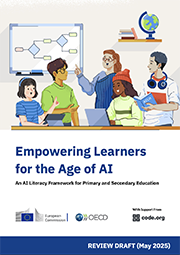
Empowering Learners for the Age of AI by European Commission and OECD

A great deal of discussion about AI, especially generative AI and large language models, still centers on academic integrity, how AI can help teachers and reduce burnout, and the future of work. As the AI genie is not going back into the lamp (of learning?), teachers and educational leaders need to focus on students—how should they be prepared for a world where AI is ubiquitous? Enter the AILit Framework, developed through the collaborative efforts of the European Commission (EC), the Organization for Economic Cooperation and Development (OECD), Code.org, and international experts in technology, education, and innovation. Currently a draft document, the AILit Framework aims to provide a comprehensive guide to AI literacy for primary and secondary students. Intended for teachers, education leaders, policy makers, and learning designers, the framework goes beyond knowledge and skills to address attitudes, ethics, and critical thinking, preparing students to engage with AI now and in their post-school lives. The framework centers on four key domains—Engaging with AI, Creating with AI, Managing AI, and Designing AI—each supported by practical competencies and learner scenarios adaptable to diverse educational contexts. The framework raises social and environmental considerations, supporting a human-centered approach. The work of educators is central to preparing young people for this new world. The full draft framework is available for download and the authors welcome input ahead of their final 2026 version.

Submitted by
Wayne Burnett, AIS Abuja, Abuja, Nigeria
Current Events & Civic Engagement
Curriculum
Teaching Practice
Technology
Podcast

A Masterclass in Scientific Skepticism

You deserve better brain research by Dr. Ashley Juavinett and Dr. Cat Hicks
Change, Technically, June 30, 2025

Each episode of the delightful podcast Change, Technically is an intellectual journey, and this episode, titled “You deserve better brain research” is no exception. In this episode from the summer of 2025, hosts Dr. Ashley Juavinett, a neuroscientist, and Dr. Cat Hicks, a psychologist, examine some of the most headline-grabbing research on AI and cognitive offloading, particularly the well-known MIT Media Lab study using EEG to measure cognitive processing. They provide a masterclass in scientific skepticism, dismantling the study’s methodology, from its lack of peer review to its suspicious "brain map" visualizations. However, their critique goes deeper than mere debunking, offering an illuminating model of scientific thinking and erudite enthusiasm for the process of scientific discovery. In doing so, they challenge educators to move beyond the fear-based narrative that technology "melts" the brain. Instead, they advocate for a more nuanced understanding of "desirable difficulty" and student agency, turning our attention to how to use science to measure learning and to understand how technology shapes and structures, for better or worse, our mental processes. For independent school leaders navigating the "neuro-hype" of the AI era, this episode is a thrilling reminder that rigor belongs not just in the lab, but in how we consume the research that shapes our pedagogical choices.

Submitted by
Jonathan Gold, Moses Brown School, Providence, RI
Psychology & Human Development
Science of Learning
Teaching Practice
Technology
Book

The Bell Now

Stone Yard Devotional by Charlotte Wood
Riverhead Books, February 1, 2025

Many people think about changing their lives, but only some have the courage or capacity to follow through. For most, life change comes about by accident, as is the case for the narrator of Charlotte Wood’s resonant Stone Yard Devotional when she returns to her home town in New South Wales after decades away in Sydney. Feeling that her world is on fire, the unnamed environmentalist leaves her personal and professional ties for a simpler, if no less challenging, existence in a convent on the plains. On the way to this remote place, she stops to visit the graves of her parents, buried years prior in a rustic cemetery unchanged by time. Far from her cosmopolitan life on the first night in a convent cabin, she enjoys a silence “so thick” it makes her feel “wealthy” and experiences an emptiness at dusk after Vespers that is “shockingly peaceful.” Although she herself is not religious, the rituals upheld by those around her, along with the mundane tasks assigned to her, an unstoppable plague of mice, and an unexpected vigil, fill her with wonder and give her a new sense of purpose. “I’m growing accustomed to the bell now, that rings for the nuns at each of the liturgical hours,” she says. “It’s not meant for us civilians, but I hear its faint sound coming from the sisters’ quarters beyond the church, and find myself listening for it.” The new year brings reflection, new vows, and heartfelt promises; this novel is an excellent companion text by which to navigate a tumultuous world.

Submitted by
Jessica Flaxman, The Pingry School, Basking Ridge, NJ
Literature