Klingbrief Archive

Vol 140 - March 2026

Article

Of Note: The Value of Attention

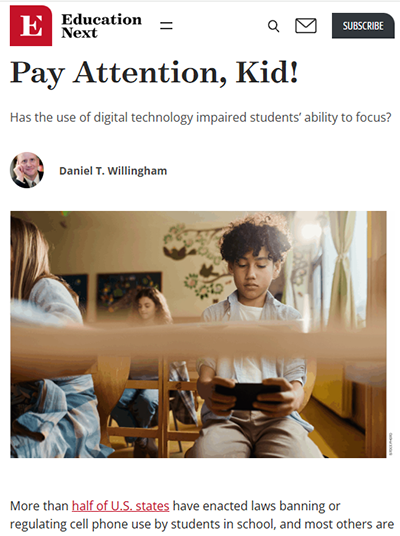
Pay Attention, Kid: Has the use of digital technology impaired students’ ability to focus? by Daniel T. Willingham
Education Next, 25(4), September 9, 2025

Are smartphones destroying attention spans, or are they simply reshaping how young people think about rewards and motivation? In “Pay Attention, Kid!” cognitive psychologist Daniel T. Willingham examines the fear that digital technology has damaged students’ ability to focus. Reviewing existing research, he finds that while screen time is often correlated with shorter attention spans, the evidence is far from proving that phones directly damage the brain's ability to maintain attention. Instead, Willingham offers an alternative argument: constant digital stimulation may change how students have learned to value attention itself. Through two key mechanisms—delay discounting (favoring instant gratification over long-term rewards) and digital comparison (judging real-world tasks as “boring” compared to digital alternatives)—technology may, in fact, be shifting students’ motivational decision-making rather than damaging their neurological ability to focus. Willingham’s argument reframes the cell phone issue: phones aren’t just distractions to consider banning, but tools that may be reshaping how students think about the rewards of focus and effort. This novel framing calls on educators to design environments and routines that teach patience, deepen intrinsic motivation, and make focus feel rewarding again.
Submitted by
Lindsey Anderson, American Community School Amman, Jordan
Psychology & Human Development
Science of Learning
Teaching Practice
Article

Maybe It’s Us

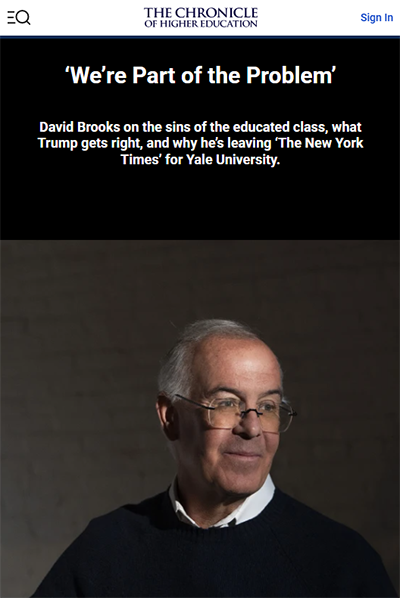
We’re Part of the Problem by Evan Goldstein
The Chronicle of Higher Education, February 17, 2026

In this Chronicle of Higher Education interview, conducted on his final day at The New York Times, columnist and author David Brooks reflects on how elite educational institutions may have unintentionally deepened social and political divides by privileging status, credentialism, and prestige over character, civic responsibility, and moral formation. Brooks, who is leaving the Times to serve as a presidential senior fellow at Yale’s Jackson School of Global Affairs, argues that universities must confront their role in shaping a meritocratic system that has deepened class divisions and eroded public trust. While sharply critical of political attacks on higher education, Brooks also suggests this is a moment for internal reform, urging institutions to reengage with the enduring human questions at the heart of liberal education. While focused on elite universities, Brooks’s critique carries clear implications for independent schools that espouse whole-child education and character formation. It invites reflection on whether graduates are shaped chiefly by achievement and resume virtues or by empathy, resilience, and civic responsibility. If the former begins to eclipse the latter, then mission statements that champion integrity, service, and moral leadership must be realized not merely in language but in the lived experience of curriculum, advising, community expectations, and daily school culture.

Submitted by
Christopher Lauricella, The Albany Academies, Albany, NY
Current Events & Civic Engagement
Leadership Practice
Teaching Practice
Article

Unscripted Joy

Assessment is Ruining Teaching by Andrew Davinack
Chronicle of Higher Education, February 13, 2026

What do you do when a student asks a genuinely interesting question that simultaneously promises to take you in an exciting direction while also guaranteeing you’ll never get through the day’s lesson plan? Wheaton College biology professor Andrew Davinack encourages us, wholeheartedly, to not worry so much about the curriculum map or lesson plan. Instead, he urges educators to engage their students, even if the process is messy and unmeasurable. Describing his response to a student’s question that delved into the socioeconomic, political, and cultural forces that affected the spread of a parasite-based disease in Syria, Davinack writes: “Needless to say, I abandoned the lesson plan entirely. The activities I had carefully designed to align with that day’s learning objectives were never used. The concepts I had planned to assess were left unexplored.” And yet, Davinack admits, “the students learned something far more consequential than what I had originally planned to teach.” Davinack is not encouraging teachers to abandon assessment altogether, but rather to reimagine it “as a reflective practice grounded in disciplinary judgments rather than a bureaucratic apparatus imposed from above. This requires restoring trust in faculty expertise, embracing qualitative and narrative forms of evidence, and acknowledging that not all meaningful learning can be specified in advance.” Teachers who have experienced moments of pure, unscripted joy in the classroom, when sublime meaning and understanding seemingly emerge out of nowhere, will do well to read, debate, and share Davinack’s essay widely.

Submitted by
Jonathan M. Schoenwald, Dawson School, Lafayette, CO
Teaching Practice
Article

Something Ineffable

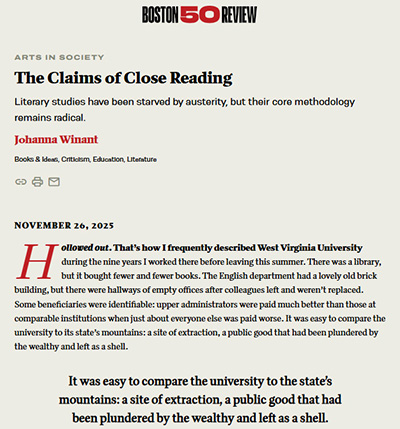
The Claims of Close Reading by Johanna Winant
Boston Review, November 26, 2025

Johanna Winant’s moving ode to close reading is the perfect counterpoint to educators’ feelings of ennui and despair in the current technological and political moment. Winant was an instructor at West Virginia University, one of many institutions “hollowed out” by political and cultural forces. Winant, however, has been heartened by her experience of teaching students the time-tested, labor-intensive, and cognitively challenging task of close reading even in the context of the declining institution. Winant is obviously a skilled, patient teacher, but her commitment to practice and praxis is sure to inspire educators looking for a deeper reflection on why we do what we do. She contextualizes her argument in favor of the pedagogical importance of close reading in a “flurry of books” from the past few years, but she grounds her reflection in her experience working with the wide cross section of students at WVU, “trying to describe how teaching can feel magical” even as she understands the cliche. Part of that magic, as Winant understands, is that teaching means that one is “always learning” from and with one’s students; Winant’s essay is a beautiful encomium to the practice of learning. Winant is candid that writing about teaching is challenging—there’s always something ineffable in the alchemic classroom experience—but Winant’s close reading skills have also made her an incisive writer, and the piece is inspiringly thoughtful about what students learn when they’re taught, and inspired, to close read, to attend and to reflect. Indeed, Winant frames close reading as a practice of sense-making grounded in noticing and good-faith argument. Although Winant reaches for “magic” to describe the transformative power of teaching, she closes by noting that teaching students to close read is a tangible, practical, and necessary skill for the current moment; it is a practice with real power.

Submitted by
Jonathan Gold, Moses Brown School, Providence, RI
Science of Learning
Teaching Practice
Book

Knowledge of Young People

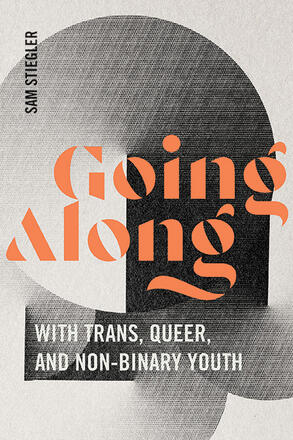
Going Along with Trans, Queer, and Non-Binary Youth by Sam Stiegler
State University of New York (SUNY Press), March 2026

What becomes visible when educators stop asking young people to explain their lives and instead walk alongside them? In Going Along with Trans, Queer, and Non-Binary Youth, Sam Stiegler challenges dominant, adult-centered narratives that politicize trans, queer, and non-binary youth and constrain what counts as “appropriate” knowledge about childhood. Drawing on a mobile “go-along” research methodology (a qualitative method in which the researcher accompanies participants through their everyday environments while listening to and talking with them, allowing insights to emerge from lived experience, movement, and place in real time), Stiegler accompanies eleven youth as they move through New York City. The interviews in motion reveal how safety, belonging, and survival are negotiated in real time, especially for those marginalized by housing insecurity, gender nonconformity, and social uncertainty. By following youths through subways, parks, and neighborhoods, Stiegler uncovers complex navigation strategies, including choosing longer routes to avoid exposure and carving out temporary refuges in public spaces where invisibility becomes a form of protection. These self-made territories allow youths to endure long, unstructured days while managing risk and self-care. Throughout, Stiegler presents these realities with notable sensitivity, foregrounding participants’ dignity while remaining reflexive about his positionality as a white, cisgender researcher. The book centers lived experiences often excluded from qualitative research, especially those of queer and non-binary youth of color. For independent and international school educators, this book reframes how knowledge of young people is understood. It calls for deep listening, relational humility, and a rejection of deficit-based assumptions, urging educators to recognize the complex, context-bound realities students navigate beyond institutional walls.

Submitted by
Monica Tiulescu, Rye Country Day School, Rye, NY
DEIJ
Gender & Sexual Identity
Student Wellness & Safety
Book

Sustainability

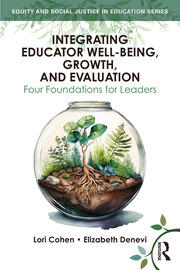
Integrating Educator Well-Being, Growth, and Evaluation: Four Foundations for Leaders by Lori Cohen and Elizabeth Denevi
Eye On Education, July 30, 2025

In Integrating Educator Well-Being, Growth, and Evaluation, Lori Cohen and Elizabeth Denevi offer a transformative vision for how schools can support educators. Framing professional learning as an interconnected ecosystem, they invite leaders to rethink evaluation as a collaborative, continuous practice that strengthens school culture and sustains educator growth. By tending to this ecosystem, schools can retain talented educators and cultivate thriving, supportive communities. The authors outline four interdependent foundations: equity, well-being, growth, and evaluation. Equity ensures fair access to resources and opportunities, while fostering inclusive conditions in which all educators and students can thrive. Well-being emphasizes resilience, reflection, and sustainable work. Growth focuses on continuous learning through coaching, mentoring, and structured feedback. Evaluation is reframed as a human-centered, ecosystem-oriented process that nurtures growth and well-being, rather than serving solely as a compliance or accountability measure. Cohen and Denevi pair these frameworks with research-based tools such as the Teacher–Student Relationship Quality (TSRQ) Matrix and the Integrated Classroom Practices for Equity (ICPE) rubric, offering concrete ways to assess instruction, classroom culture, and relational practices while embedding equity and well-being into feedback systems. Together, these ideas provide school leaders with a practical roadmap for designing evaluation and professional learning systems that are collaborative, supportive, and aligned to promote sustainable educator growth and positive student outcomes.

Submitted by
Erica Washburn, Latin School of Chicago, Chicago, IL
Leadership Practice
Article

Family, Finances, Fear, Faculty, and FOMO

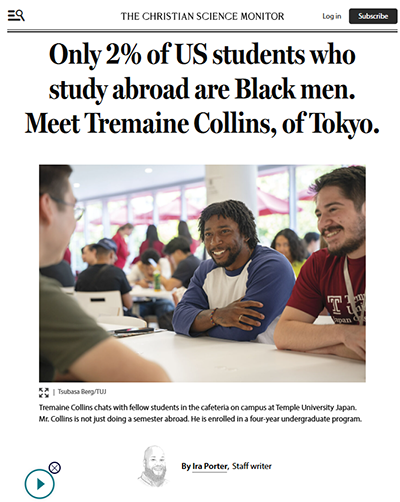
Only 2% of US students who study abroad are Black men. Meet Tremaine Collins, of Tokyo. by Ira Porter
The Christian Science Monitor, December 13, 2025

International student enrollment has declined in several major destinations, including the United States, Canada, and the United Kingdom, prompting renewed interest in study-abroad opportunities that facilitate students' global experience. Studying abroad offers students the chance to travel, experience other cultures, and broaden the perspectives they bring back to their home campuses and communities. And yet, as the title of a recent article by Ira Porter points out, “only 2 percent of US students who study abroad are Black men.” By profiling one such student, Tremaine, Porter identifies some of the challenges of studying abroad. Porter cites a decades-old paper from Spelman College that identifies four barriers to study-abroad participation: family, finances, fear, and faculty. One might add a modern fifth: the fear of missing out on opportunities at one’s home university. Written for high school counselors and university study-abroad advisors interested in diversifying who goes abroad, the article may also resonate with students themselves. Tremaine speaks about his desire to try new things and travel; his optimism, along with the experiences of other students featured in the article, highlights the possibilities that study abroad opens up. As he says, “I think my older self is going to be proud of my younger self.”

Submitted by
Wayne Burnett, AIS Abuja, Nigeria
DEIJ
Teaching Practice