Klingbrief Archive

Vol 143 - September 2026

Book

Of Note: Crisis as Lever

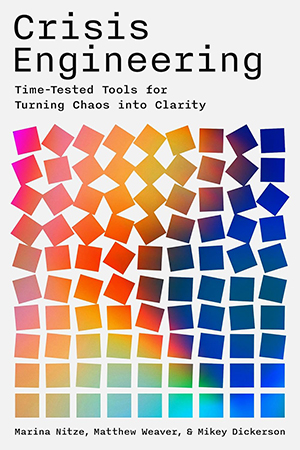
Crisis Engineering: Time-Tested Tools for Turning Chaos into Clarity by Marina Nitze, Matthew Weaver & Mickey Dickerson
Balance, April 2026

Crisis Engineering: Time-Tested Tools for Turning Chaos into Clarity provides insight into how humans react to crisis-level events and offers encouragement to navigate crises through shared sensemaking, clear communication, and novel action. The authors draw on personal experience using case studies of large-scale events, such as the Three Mile Island nuclear disaster and the healthcare.gov launch, creating a crisis toolkit that helps organizations mitigate crisis conditions and, perhaps most importantly, identify and sustain meaningful change. This deeply practical book serves not only as a scalable guide for crisis management, but also as a roadmap to leverage difficult circumstances to break old institutional patterns and create new ones. For example, in “Map the System” and “Find Your People,” the authors posit that sensemaking is inherently social and that a crisis allows you to “cocreate a plausible shared reality of how information actually flows across the organization.” The realities surfaced often create cognitive dissonance that pushes people to reimagine what is possible, establish better measurements of progress, and engage in rapid, iterative action plans that would have previously seemed out of reach. Additional sections focus on crisis communications, concluding crisis operations, and learning how to “Plan for a Future Crisis.” Crisis Engineering provides school leaders with an opportunity to rethink emergency operations and response teams, as well as insight into organizational sensemaking that can be leveraged across diverse circumstances to move an organization forward.
Submitted by
Jessica May, Klingenstein Center, Teachers College, New York, NY
Leadership Practice
Book

The Power of a Question

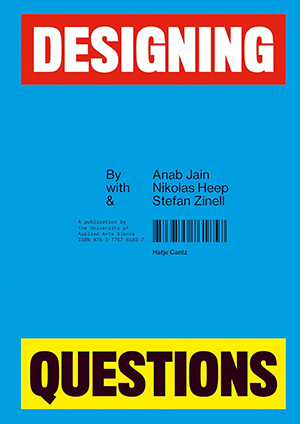
Designing Questions by Anab Jain, Nikolas Heep, and Stefan Zinell
Hatje Cantz, June 2, 2026

“What does a hopeful future truly look like?” A student’s question opens Designing Questions, a book from the Design Investigations department at Vienna’s University of Applied Arts. Its central claim: In the face of converging crises and swift change, the most radical act may be to reclaim the power of questions. Each chapter features an essential question as its title: How do we design questions? Why should design speculate? How do we investigate through making? How do we design when everything is entangled? Can designing questions shape our futures? Drawing on scholars including bell hooks, Gloria Anzaldúa, and Vanessa de Oliveira Andreotti, Designing Questions enacts a pedagogical shift in design: from inside to extending the discipline; from solutions toward “questions, speculations, and emergence”; from making as execution toward making as inquiry; and from fixed intelligence toward relational, situated intelligence. Designing Questions presents the classroom as a space for curiosity, embodied understanding, and imagination. It makes a compelling case for inquiry as core to learning and making. Ultimately, it insists that hope lives in “rehearsing other worlds together.” Teachers and leaders building interdisciplinary, project-based, or future-focused programs will find provocation, inspiration, models, and permission here.

Submitted by
Nicole Furlonge, Klingenstein Center, Teachers College, New York
Curriculum
Teaching Practice
Creativity
Article

Never My Doctor

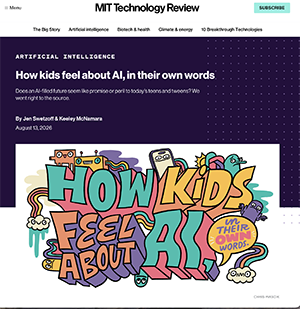
“How Kids Feel About AI in Their Own Words” as told to Jen Swetzoff and Keeley McNamara
MIT Technology Review Vol. 129 No. 5 September/October 2026

‍

Adults everywhere are talking about AI – what it is, how it’s used, and what its impact on school, life, and society may be in the near and not-far future – but what do kids themselves think about the phenomenon? To find out, Jen Swetzoff and Keeley McNamara, founding editors of Anyway magazine for tweens and teens, asked them. Unsurprisingly to educators who work with them on a daily basis, the students’ opinions on AI were both nuanced and sophisticated. Remy, 16, of New York, chose the word “indifferent” to describe their feelings on the topic. “I teach taekwondo. I read. I play games with friends. None of that needs AI. I mean, I use it (Claude, the free version)… but at school, I actually think AI mostly makes my assignments worse, not better.” Danielle, 18, of California, worries that blind trust in AI will breed misinformation, disinformation, and bias, while Wesley, 14, of Ohio, is concerned that AI will “[rob] us of our ability to think creatively, to think for ourselves.” Evelyn, 13, of Oregon, hopes to be a doctor and sees the benefits of AI tools, but feels strongly that humans, not machines, should provide care to others. “I never want it to be my doctor,” she says. And then there's Krishiv, 17 of Ontario, who believes that the most important competencies for students to develop in the age of AI are “initiative, judgment, and self-direction.” Although there is plenty to keep teachers and school leaders up at night concerning AI, Swetzoff and McNamara's research strongly suggests that the kids are still all right.

Submitted by
Jessica Flaxman, The Pingry School, Basking Ridge, NJ
Psychology & Human Development
Technology
Science of Learning
Video

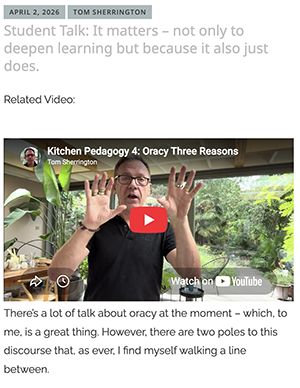
Kitchen Pedagogy

Tom Sherrington’s writings and videos offer teachers clear guidance and actionable practices with a mix of deeper philosophical claims, as well. His April 2026 blog post, provocatively titled “Student Talk: It matters – not only to deepen learning but because it also just does,” should give readers new to Sherrington’s work a taste both of his deeply-held beliefs about the classroom as well as his blunt, clear-eyed style, all with the goal of creating classroom environments where learning happens by design. This particular piece is built around an installment of Sherrington’s “Kitchen Pedagogy” video series focused on “oracy” and the importance of student participation in the classroom. It also aims to push back against those who doubt the value of pair talk, cold-calling, and other Sherrington-endorsed tools for promoting student talk – and thinking – in the classroom. Indeed, Sherrington is aware that his radical commitment to constant student voice in the classroom faces opposition, often from teachers “constructing a faux cogsci case or opportunity cost argument to mask their personal discomfort with running a room where every student is talking,” and he spends much of this post dismantling the arguments against an oracy-oriented classroom. Sherrington sees a middle path in which teachers “should all be working to develop routines around pair talk such that every student has the opportunity to express their ideas verbally multiple times in a lesson – whenever the teacher decides, but with a high frequency – alongside cold calling and using show-me boards.” A witty mix of pedagogical praxis and philosophy, Sherrington’s approaches – typified by this blog – belong in more departmental and divisional conversations about how best to design the classroom for deep, meaningful learning.

Submitted by
Jonathan Gold, Moses Brown School, Providence, RI
Teaching Practice
Science of Learning
Resource

A Gift or Seven

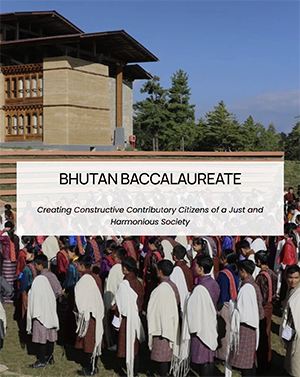
Bhutan Baccalaureate Learning Process
Druk Gyalpo’s Institute

Bhutan’s Gross National Happiness index is well known as a more holistic alternative to GDP, incorporating factors beyond wealth to assess the country’s progress and to inform policy. It is therefore interesting to encounter an educational framework from the same kingdom that takes a similarly holistic view of human development. The Bhutan Baccalaureate, which begins with early childhood and extends through Grade 12, is a reform effort being implemented in Bhutanese schools. The Baccalaureate identifies five interconnected areas of development: social, emotional, physical, spiritual and cerebral. The Baccalaureate takes a familiar early-childhood practice — show-and-tell — and develops it into something much more substantial through its “Seven Gifts.” Learners bring cultural artifacts and experiences to school, including songs, patterns, and languages. The Gifts position community as a source of knowledge and invite learners to connect what they encounter at home with what happens at school. Show-and-tell therefore becomes a way to recognize, preserve, and build on the knowledge learners bring with them. The framework also offers educators some provocative alternatives to familiar ideas about what schools are for. While many independent schools include growing leaders in their missions, the Baccalaureate emphasizes developing a “Person of Substance.” The Baccalaureate's Attributes of School Excellence also invite a more fundamental question: What might your school look like through a framework that emphasizes, among other things, nurturing individualism, cultivating purpose, and finding joy in learning?

Submitted by
Wayne Burnett, AIS Abuja, Nigeria
Psychology & Human Development
Science of Learning
Social-Emotional Learning
Teaching Practice
Article

Reading Matters

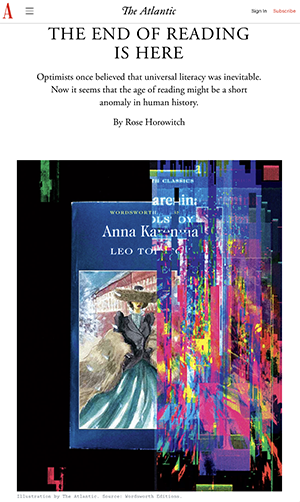
The End of Reading is Here by Rose Horowitch
The Atlantic, August 2026 issue

Two thousand years after the loss of the Library of Alexandria, knowledge acquired through deep study in print media is facing another crisis. Rose Horowitch takes readers of The Atlantic through a concise history of orality, literacy, and the dire “post-literate” digital age. She recounts the cries of impending doom when the novel, newspaper, and television critics sounded the alarm in generations past. But the statistics (and personal experience of many educators) in the current day are damning. Surveys on reading habits and time use are dismal. Literacy scores are declining among both adults and children. The Flynn effect (IQ scores rising between generations) is now reversing course. Now, we habitually decode thousands of words daily in short fragments that require limited attention or comprehension. The cognitive skills required and enriched through sustained effort in reading are eroding in our collective consciousness. Our current political state is capitalizing on this moment of diminished reasoning. There are holdouts, especially among teachers and in schools. When phones are banned, library book circulation increases significantly. Some students still find pleasure in the personal growth they experience through the concentration and reasoning required for reading and writing. The author’s personal experience with family modeling and inspiring teachers holds out a glimmer of hope for us in schools.

‍

Submitted by
Kathryn Kaiser, The School at Columbia University (retired), New York, NY
Science of Learning
Teaching Practice
Technology
Book

To Be Reminded

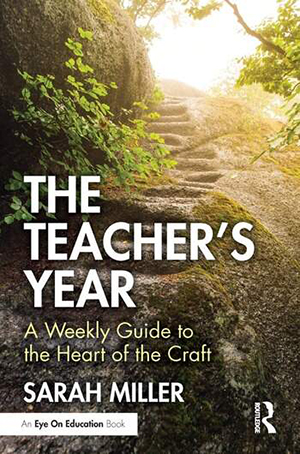
In the tradition of soul-focused educators such as Parker Palmer, Regie Routman, and Gholdy Muhammad, Sarah Miller's The Teacher’s Year: A Weekly Guide to the Heart of the Craft combines poignancy, humor, and practicality in an indispensable guide for new and veteran teachers alike. A North Carolina independent school teacher, Miller invites us "to attune your real, day-to-day classroom life with your best teacher self." Through the book, Miller aims to "support you through the craziness and coherence of school so that you will have a good year, and so you will know how essential you are to your students and your community.” The book is divided by month and by week, with tips interspersed throughout chapters such as "October: 90% Slog, 10% Grace" and “June: Even the Word Itself Sounds Peaceful." To read "The Teacher's Year," even dipping in and out of it, is to be reminded of the grace, gratitude and joy that can emerge from the sometimes-chaotic daily life of a school.

Submitted by
Sarah Cooper, Flintridge Prep, La Canada, CA
Teaching Practice