Klingbrief Archive

Vol 144 - October 2026

Book

Of Note: Seemingly Random Flashes

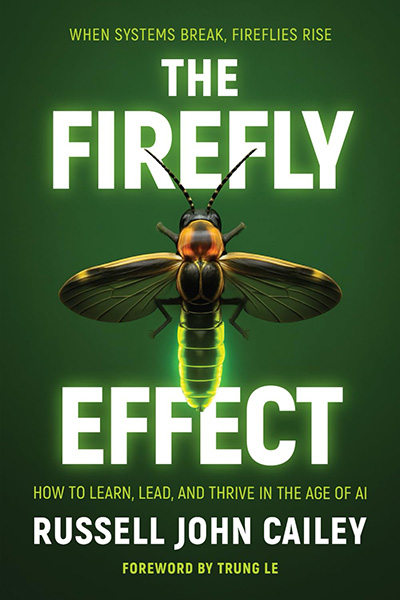
The Firefly Effect by Russell John Cailey
Game Changer Publishing, September 18, 2025

What happens when change moves faster than an institution’s ability to respond? In education, this is no longer a hypothetical question. Rapid technological change, expanded access to information, and AI are challenging fundamental assumptions about what students need to know, how they learn, and how schools prepare them for an uncertain future. In The Firefly Effect, Russell John Cailey challenges educators to reconsider the structures and timelines that shape learning. As AI accelerates knowledge acquisition and task performance, he advocates for regenerative learning cycles that cultivate brilliance rather than reproduce rote, assembly-line models. The firefly offers a compelling metaphor: seemingly random flashes synchronized through a living network without centralized command. Applied to education, this model suggests that innovation can emerge through human connection, distributed agency, and collective intelligence. The challenge is not to abandon strategic planning, but to build institutions capable of continuous adaptation. Schools must pair enduring commitments with flexible practices, shorter cycles of experimentation and reflection, and empower educators to respond to emerging needs. Rather than positioning technology and human intelligence as competing forces, schools should harness their complementary strengths to amplify learning and innovation. Ultimately, a school’s greatest strategic advantage may not be its ability to predict the future, but its capacity to learn, adapt, and regenerate as the future unfolds.
Submitted by
Tracey Goodson Barrett, Gill St. Bernard's School, Gladstone, NJ
Current Events & Civic Engagement
Leadership Practice
Technology
Book

Critical to Democracy

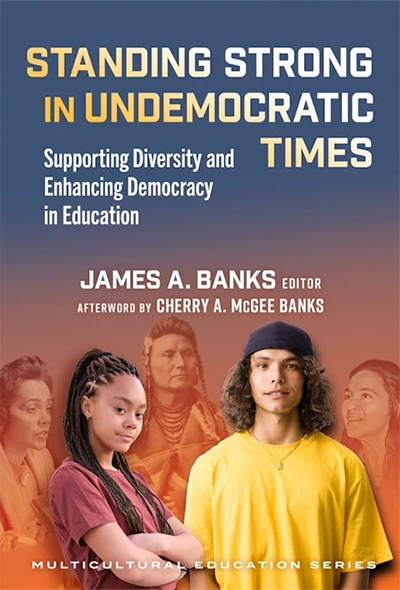
Standing Strong in Undemocratic Times: Supporting Diversity and Enhancing Democracy in Education by James A. Banks, editor
Teachers College Press, April 24, 2026

James Banks, in this edited collection of essays, reminds us that we have repeatedly seen deliberate and coordinated government opposition to moments in history when African Americans have made progress in participating fully in our democracy. The Civil War, Reconstruction, the Civil Rights and Voting Acts all resulted in new ways of formally excluding. Banks brings together preeminent scholars to reflect on the current moment, predict our future, and recommend strategies to move forward. These essays bring us authors who range from the "progenitors," to researchers who emerged from them, and to the “new generation.” While our teachers, administrators, and students resist the political climate, these perspectives and ideas are a call to action. Ladson-Billings, in “Surviving a Second Nadir,” reminds us that we have lived and continue to live in a “political pendulum.” She provides a bulleted list of steps we must take to survive the hard swing backward. Wayne Au, one of the editors of Teaching for Black Lives, shares the tremendous positive impact that ethnic studies has been demonstrated to have on all students. In “Redefining Membership: Executive Actions and the Boundaries of Citizenship,” Angela Banks advises us to teach students about historical citizenship criteria, fluid definitions, and active membership in a democracy. This collection is a balm, reminding educators that we are critical to democracy and play an essential role in our collective future.

Submitted by
Kathryn Kaiser, The School at Columbia University (retired), New York, NY
Current Events & Civic Engagement
DEIJ
Article

Throughlines and Faultlines

The Science of Learning Taxonomy by Benjamin Riley
Substack, August 17, 2026

Blogger and journalist Benjamin Riley is likely a well-known figure for those who follow discussions of AI and cognitive offloading (not to mention his recent exposeés on Alpha School), but his original beat was more focused on the science of learning (SOL) at his well-regarded site, Cognitive Resonance. In this exhaustive piece, Riley offers a useful, fascinating “taxonomy” of the science of learning. Even with his up-front caveats that this framework represents his “individual perspective,” the overview is an incredible primer on the various throughlines and faultlines in an emerging, complex field. Riley organizes his piece around identifying the main assumptions, nuances, key figures, and critiques of each “camp” within the science of learning. In doing so, he explores the affinities and disjunctures between approaches that fall under this expansive heading while also exploring some of his own analysis of the strengths and weaknesses of each. For example, in discussing neuroscience-grounded science of learning, he claims that he doesn’t “think teachers need to know much of anything about how the brain functions.” He’s also uniquely attuned to “grifters” and others who exploit the claims of “science” to promote approaches that are not actually research-based or, in his view, all that effective. Riley also takes apart some of the EdTech hoopla around so-called science of learning-infused platforms and products. All of this is aligned with a goal shared by teachers and school leaders, especially Klingbrief readers: helping to keep the discussion focused on what tools and approaches might best support student learning.

Submitted by
Jonathan Gold, Moses Brown School, Providence, RI
Science of Learning
Teaching Practice
Article

Beyond the Averages

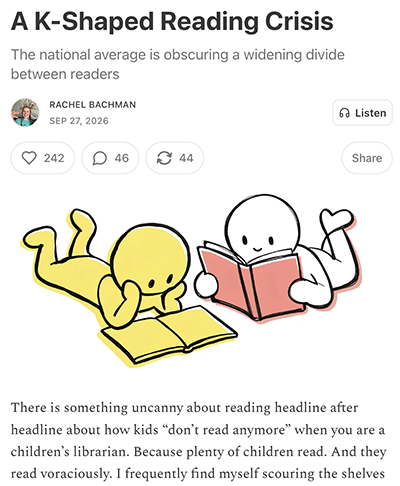
A K-Shaped Reading Crisis by Rachel Bachman
Substack: Excuse My Whimsy, September 27, 2026

Many education articles discuss the decline in reading skills and the drop in how much children and teens read for pleasure. Young people are reading less, on average, while national and international assessments report falling reading scores. But what if the average, a single statistic, is limiting our understanding of what is really happening? Rachel Bachman, a children's librarian, describes a daily experience that illustrates the problem. Some children visit the library as though they were visiting the dentist, while others come regularly and happily, voraciously reading their way through the collection. Looking more closely at the data, Bachman finds that reading achievement is not moving in the same direction for all students. NAEP data show that, compared with 1992, fourth-grade students at the lower percentiles scored worse in 2024, while those at the higher percentiles scored better. The national average obscures these differences, making it harder to understand which students are struggling and how their needs differ. Bachman offers a deeper understanding of reading issues, and she explores the implications of these widening differences. Teachers face an increasingly wide range of reading abilities, making it difficult to find a novel that works for an entire class or to provide different books without adding considerably to their workload. Librarians need collections that accommodate a broad range of interests and reading levels. Educational leaders, in turn, need to understand the data for their own schools and communities and support teachers and librarians as they respond to these differences. Bachman's central argument is that there is no single reading crisis affecting all children in the same way. Understanding what is happening requires looking beyond the average and paying closer attention to the students at either end of the distribution.

Submitted by
Wayne Burnett, AIS Abuja, Nigeria
Teaching Practice
Article

Access to Challenging Work

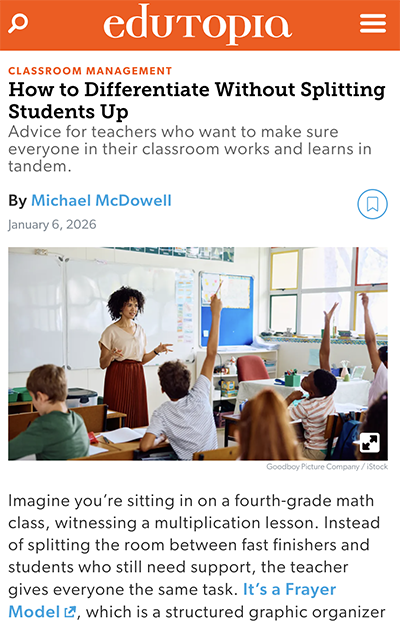
How to Differentiate Without Splitting Students Up by Michael McDowell
Edutopia, January 6, 2026

Independent schools champion both academic rigor and individualized learning. However, too often, we treat these commitments as competing priorities. What if the challenge is not choosing between them but rethinking how we deliver both? Michael McDowell’s “How to Differentiate Without Splitting Students Up” challenges the notion that differentiation requires dividing students by ability. He offers practical strategies that invite students to engage in shared intellectual work through accessible entry points and purposeful questioning. In mathematics, for example, students can approach the same problem with vastly different levels of confidence and preparation. Regardless, difference should not determine who gets access to challenging work. McDowell’s approach reminds us that rigor is not measured by how difficult we make learning to access, but by the quality of thinking we ask students to do. For independent schools, this conversation extends beyond individual classrooms. As students evolve, so must our curriculum, professional learning, and instructional practices. The question, then, becomes whether we are willing to rethink the structures that have traditionally defined rigor, instead of whether we can maintain high expectations while differentiating.

Submitted by
Kiamani Wilson, Episcopal High School, Washington, D.C
Science of Learning
Teaching Practice
Book

Arm’s Reach

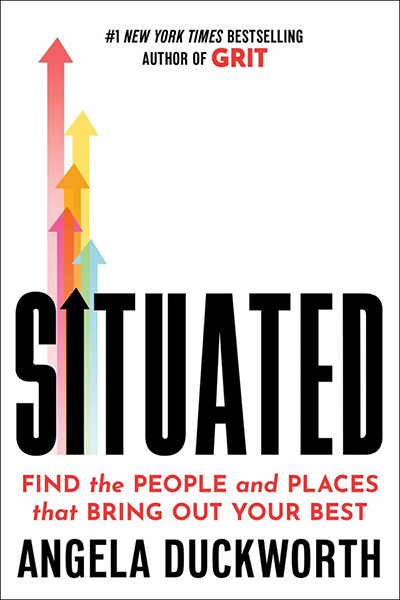
Situated: Find the People and Places That Bring Out Your Best by Angela Duckworth
Scribner, September 1, 2026

Ten years after Grit, Angela Duckworth's Situated: Find the People and Places That Bring Out Your Best asks what effort is worth in the wrong setting. Her answer is that grit matters but does not do the work alone. Much of what we do and how motivated we feel comes from our immediate circumstances. The objects within arm's reach, the peers and mentors around us, and the places where we live and work all shape what we achieve. Drawing on behavioral science, Duckworth moves through three stages. "Situational awareness" means noticing how our surroundings shape what we do, think, and feel. "Situational agency" means setting up our space, picking our peers, attracting mentors, and choosing our culture. "Situational responsibility" means creating better conditions for those with less power to change their own situations. That final stage carries particular weight for school leaders who design the structures students and adults experience every day. How a school organizes advisory, peer groups, and teacher teams becomes a question of how well others are set up to succeed. The book invites leaders to ask what situations they have designed well, and for whom. It also asks how every student can gain access to mentors and how schools can support them in building agency over their own circumstances. Situated offers a practical lens for examining a school's spaces, relationships, and norms, and for asking whether they help children and adults to thrive.

Submitted by
Ashley Hayes, American Community School, Amman, Jordan
Psychology & Human Development
Leadership Practice
Teaching Practice
Website

From Messy to Deep

Staying Human by Dr. Vivek Murthy
Substack, October 6, 2026

Dr. Vivek Murthy, the former surgeon general of the United States, is perhaps best known among educators for naming isolation and loneliness as public health threats and for sounding the alarm about youth mental health. His blog, aptly named Staying Human, invites a conversation “about how to navigate our messy world to find deep, lasting fulfillment,” with each post offering a reminder of how to keep learning what it means to be human. In “The Two Sides of Mattering”, Murthy reflects on what it means to matter, offering the important reminder that, “We matter simply because we exist.” In “Finding Joy in Tough Times,” he cautions readers against falling “into the trap of thinking that joy appears only when everything is going perfectly.” His latest post, “The Gift of Feeling Small” shows how awe is more than a pleasurable sensation: it can reshape our perspective and the ways we engage with the world around us. Drawing on the research of UC Berkeley’s Dr. Dacher Keltner alongside his own experiences, Murthy describes feeling small not as feeling insignificant, but as feeling like a part of something larger. At one point, he realizes, “Sometimes, what I need when I am overwhelmed is not for my problems to disappear, but a reminder that my problems are not the whole world.” For schools and educators working to protect and improve the wellbeing of our students, Staying Human offers reflections that can inspire us all to be a little more human with one another.

‍

Submitted by
Deepjyot (Deep) Sidhu, Klingenstein Ed.D. Candidate, Cary Academy, Raleigh, NC
Psychology & Human Development
Social-Emotional Learning