Klingbrief Archive

Vol 145 - November 2026

Book

Of Note: Notice, Affirm, Need

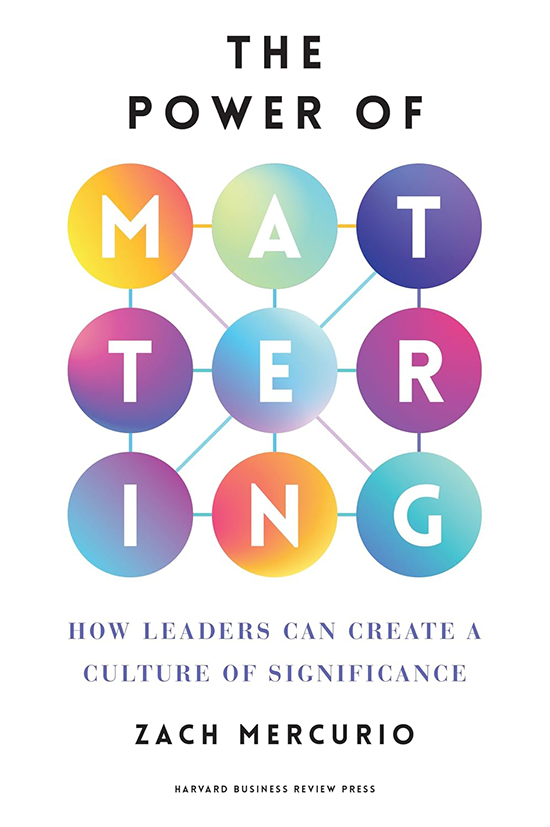
The Power of Mattering by Zach Mercurio
Harvard Business Review Press, May 13, 2025

In a fast-paced and ever-changing world, there is power in mattering. Being seen matters. Being appreciated matters. Feeling that our contributions are valued matters. And being part of an authentic, encouraging, and healthy community matters deeply. In The Power of Mattering, Zach Mercurio tackles the growing sense of fragmentation within organizations, including schools struggling with teacher and staff retention, and offers leaders a framework for both recognizing the significance of individual contributions and helping those same individuals feel valued. Blending research, personal experience, and stories from university custodial staff, educators, and industry leaders, Mercurio explores how people who feel they matter experience greater physical and psychological well-being, motivation, connection, and resilience. He suggests three key practices that leaders can adopt to cultivate a culture of mattering: noticing, affirming, and needing. Throughout the book, Mercurio unpacks these pillars, exploring what mattering means, why it matters, and how leaders can put it into practice within their own contexts. Ultimately, this book invites readers to reflect critically on relationships and structures within their communities and, more importantly, to take meaningful action to build a lasting culture of belonging where everyone feels seen, valued, and needed.
Submitted by
Bianca Nunes, American School of Brasilia, Brasilia, Brazil, and Ketsia Julmeus, Annunciation Catholic School, Miami, FL
Leadership Practice
Psychology & Human Development
Teaching Practice
Book

Only a Minute

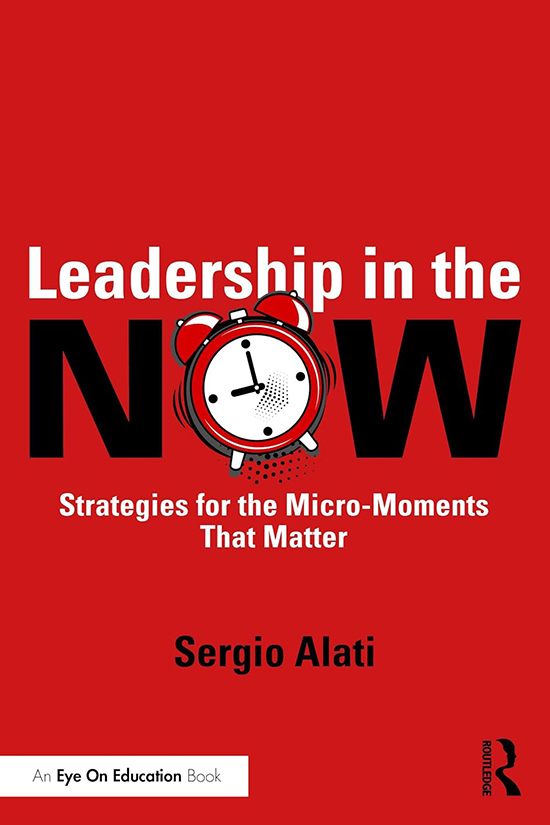
Leadership in the Now: Strategies for the Micro-Moments That Matter by Sergio Alati
Routledge, September 16, 2026

“Do you have a minute?” In a world accelerating under the influence of technology and AI, a minute can feel like a precious commodity. Yet, as Sergio Alati reminds us in Leadership in the Now: Strategies for the Micro-Moments That Matter, what matters most is not how much time we have, but how we choose to invest it. A veteran Head of School in the independent school sector, Alati draws on his own leadership experiences to explore how seemingly small interactions shape effective leadership. He invites readers to cultivate greater self-awareness as a foundation for connecting with, engaging, and empowering colleagues while advancing the collective work of an organization. Alati frames leadership as a dynamic practice, guiding readers through three concentric circles of development: the Inner Game, the Outer Game, and the Long Game. Each encourages reflection on who we are, what we value, how we show up, and how our individual practices align with organizational goals. He also recognizes that our professional and personal lives are deeply intertwined, each shaping the values and behaviors we bring to the other. Perhaps the greatest test of leadership comes during a crisis, when challenges feel overwhelming and the path forward is unclear. Ultimately, Alati challenges us to look beyond titles and authority. Leadership is revealed in the moments when we listen with intention, make time for others, and create space for people to feel valued and heard. In an increasingly accelerated world, the most consequential moments of leadership may last only a minute.

Submitted by
Tracey Goodson Barrett, Gill St. Bernard's School, Gladstone, NJ
Leadership Practice
Book

Never Merely Personal

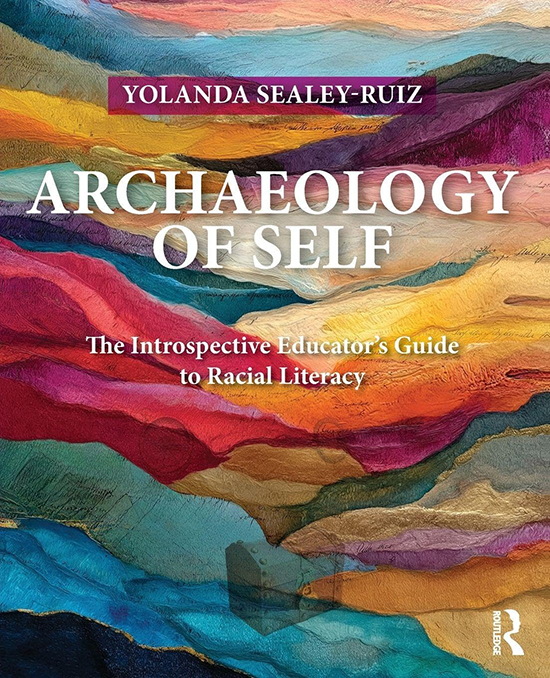
Archaeology of Self: The Introspective Educator’s Guide to Racial Literacy by Dr. Yolanda Sealey-Ruiz
Routledge, June 25, 2026

‍

For poet and scholar Dr. Yolanda Sealey-Ruiz, effective teaching and leading begin with self-interrogation. Much professional literature urges us to lead from an authentic self. Archaeology of Self: The Introspective Educator’s Guide to Racial Literacy asks us first to examine that self, a site to excavate where cherished values lie alongside inherited assumptions about race we must uncover and unlearn before we can fully see our students and design for their learning and flourishing. Through memoir, poetry, and guided reflection, the book extends Sealey-Ruiz’s Racial Literacy Development Model. Placing personal history within collective histories of race and power, she shows that self-knowledge is never merely personal nor an end in itself: confronting bias equips us to change policy and practice. Prompts, mindfulness practices, lesson plans, and playlists guide readers’ archaeological practice. The book can also support collective excavation. A leadership team might revisit a consequential decision through the model’s six components. Departments might reexamine everyday practices. A board might ask whether its mission guides the school’s actions. Grounded in critical love, Archaeology of Self is a generous companion for those willing to dig together.

Submitted by
Nicole Brittingham Furlonge, Klingenstein Center, New York, NY
Current Events & Civic Engagement
DEIJ
Psychology & Human Development
Article

Decline, Offloading, and (Now) Stunting

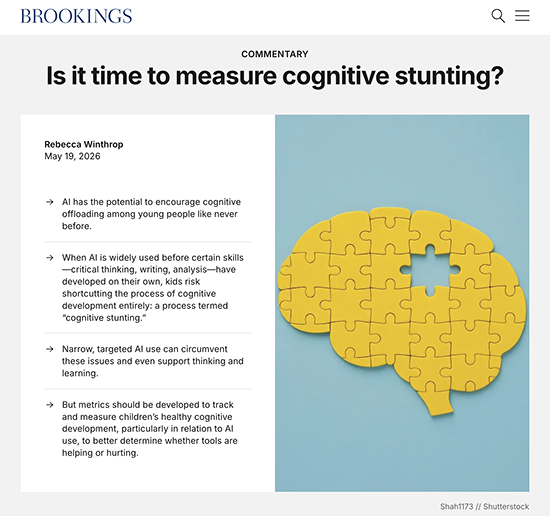
Is It Time to Measure Cognitive Stunting? by Rebecca Winthrop
Brookings Institution, May 29, 2026

Many educators sense that generative AI poses risks to students' intellectual development but struggle to articulate precisely how. While leading the Brookings Global Task Force on AI and Education, Rebecca Winthrop encountered this challenge firsthand. Her research led her to propose the term cognitive stunting to describe the potential consequences for students' intellectual development. Unlike cognitive decline, which involves the deterioration of existing abilities, cognitive stunting occurs when students fail to develop those abilities in the first place because they bypass the intellectual work necessary to acquire them. Winthrop also distinguishes cognitive stunting from cognitive offloading, the use of external tools to reduce mental effort. While she acknowledges that offloading is neither new nor inherently harmful, she points out that generative AI now allows students to delegate tasks essential to learning, including generating ideas and constructing arguments. By bypassing the practice, struggle, and reflection necessary to develop these abilities, students risk stunting their growth. As she observes, “Cognitive development, like learning to ride a bike, cannot be outsourced.” The concern is therefore not simply what students offload, but when and why. Early research raises similar concerns. Winthrop cites studies linking AI reliance to weaker critical thinking and reduced neural engagement during writing. Although these findings do not establish lasting developmental harm, they underscore the need for systematic measurement. 

Submitted by
Thomas Hamilton, Canterbury School, New Milford, CT
Psychology & Human Development
Science of Learning
Teaching Practice
Book

Cats in Hats

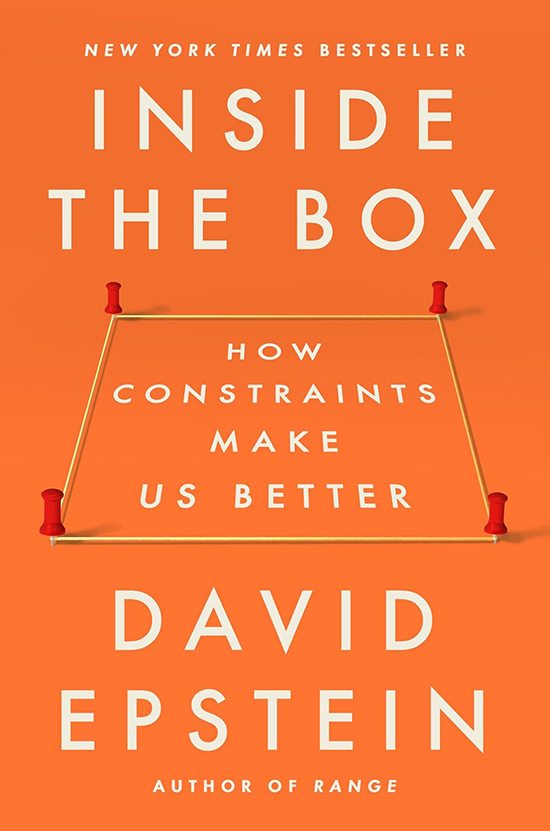
Inside the Box: How Constraints Make Us Better by David Epstein
Riverhead Books, May 26, 2026

‍

The spark of David Epstein’s new book Inside the Box, is seeing how many different kinds of limits can help us be more productive, imaginative, and efficient. Epstein contrasts many examples such as the spectacular failure of General Magic, the visionary start-up that foresaw the iPhone years ahead of its time but crashed and burned due to the lack of parameters. Unlimited freedom, money, and time contributed to a lack of structure and cohesion. In a contrasting example, Epstein cites Pixar, who set up clear work structures and limitations that enabled them to create the first computer animated feature film. Epstein goes on to detail how other kinds of limits can profoundly influence ones’ work for the better. He documents Isabel Allende’s writing routine where she works in an empty room and starts all her books on the same calendar day of the year. Bach’s self-imposed composed constraints allowed him to become one of the most important musicians in history. Dr. Seuss created The Cat in the Hat by working with a limited list of words. Epstein’s message is that we can all find ways to create a box to work within. Teachers can support students by setting clear parameters which in turn limit obstacles that increase cognitive load. The examples go on and on and Epstein weaves them together by giving himself constraints in how he organized the book: Four parts documenting different perspectives on setting limits each with three chapters supporting the theme. While the basic premise of Epstein’s book makes intuitive sense, his masterful storytelling and eye-opening lenses allow you to rethink the benefit of not having absolute freedom.

Submitted by
Jessica Leiken, Montclair Kimberley Academy, Montclair, NJ
Creativity
Science of Learning
Teaching Practice
Book

Outside the Box

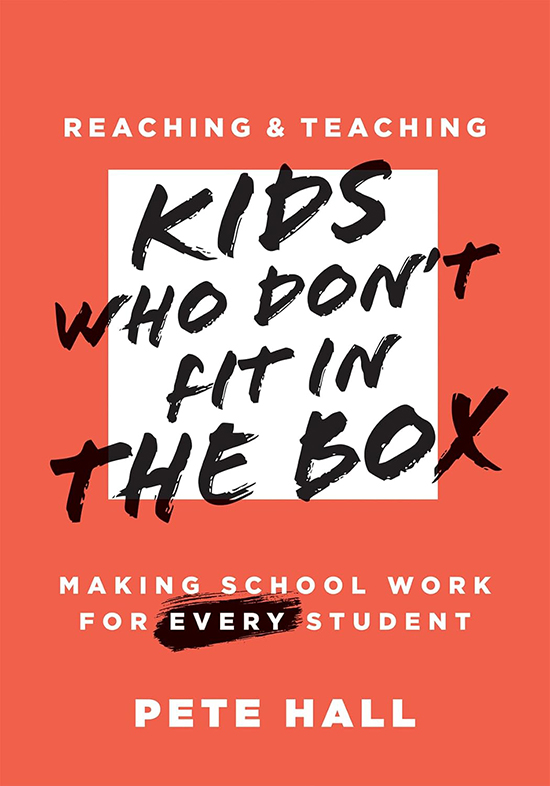
Independent schools often pride themselves on educating the whole child, yet their established norms may unintentionally leave some students struggling to belong. In Reaching and Teaching Kids Who Don’t Fit in the Box, Pete Hall challenges educators to reconsider expectations that students should learn, behave, and succeed in the same ways. Hall writes, “Some kids, for a variety of reasons, just don’t fit in with other kids. They stand out. That’s why they don’t fit in the box.” Through chapters centered on students facing academic, behavioral, and emotional challenges, Hall encourages educators to examine their assumptions and respond to individual needs. The appendix offers a comprehensive list of practical tools, organized by chapter and page number, for educators committed to serving each child. The “Name That Emotion” tool is particularly relevant for independent school practitioners supporting students navigating racial or political tensions. Hall’s framework also invites reflection beyond academics and discipline: How might institutional norms and responses to sensitive issues affect students’ sense of belonging? And, rather than expecting students to fit our schools, are we willing to build schools that fit our students?

Submitted by
Patience Lusamba, Newark Academy, Livingston, NJ
Student Wellness & Safety
Social-Emotional Learning
Science of Learning
Teaching Practice
Article

Because It Is Difficult

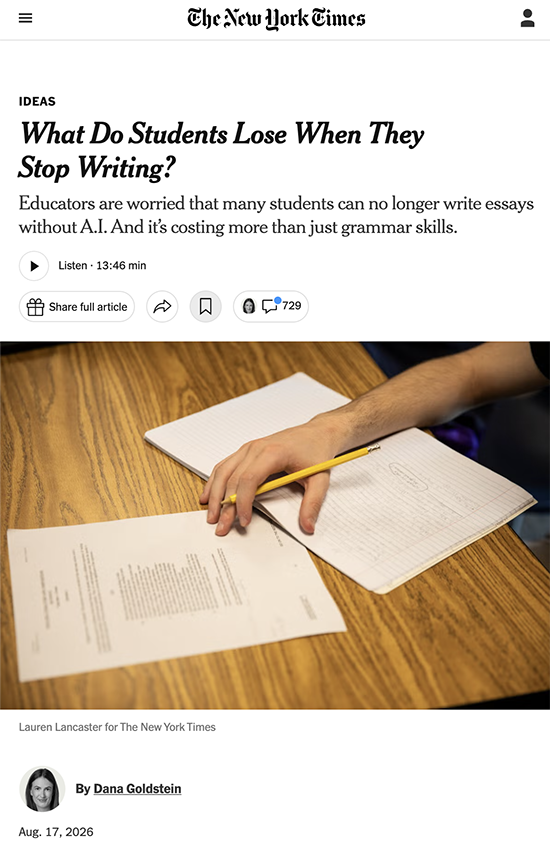
What Do Students Lose When They Stop Writing? by Dana Goldstein
The New York Times, August 17, 2026

‍

Surveys suggest that between two-thirds and 90 percent of high school and college students already use AI for schoolwork. Meanwhile, technology companies market writing assistants to schools as essential job preparation. But what happens to student thinking when the hardest part of writing disappears? In “What Do Students Lose When They Stop Writing?” education reporter Dana Goldstein argues that composing an essay without help is valuable because it is difficult. Goldstein draws upon research linking writing to working memory, planning, and metacognition, in general, and to the work of psychologist Ronald Kellogg, in particular. Indeed, Kellogg found that drafting a persuasive essay is as mentally taxing as digging a ditch is physically. Additionally, a small MIT study found that writers who worked with chatbots showed lower brain activity and struggled to remember what they had written. Even the study modes that Google and OpenAI market as writing guides produced polished paragraphs once Goldstein asked for an example. For independent and international school leaders drafting AI policy, Goldstein’s account of the University of Sydney’s two-lane approach is a concrete starting point. Rather than choosing between a ban and full adoption, a school can decide which assessments students must write alone, and where AI may support feedback and revision.

Submitted by
Eduardo Miguel Zevallos, North Zealand International School, Denmark
Teaching Practice
Technology
Article

Get Lost

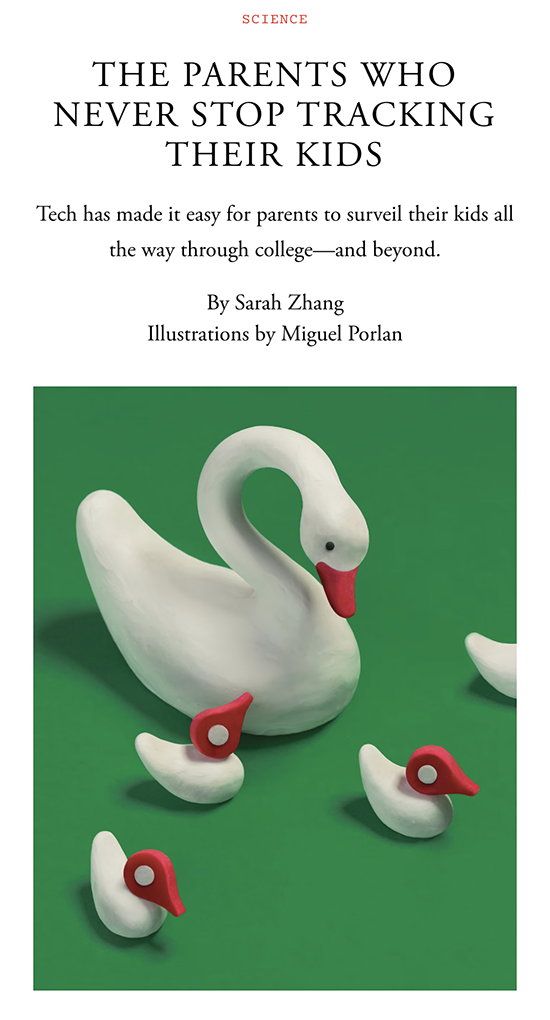
Some of the most well-known stories depend on a formerly universal human experience, that of getting lost. Hansel and Gretel, Alice in Wonderland, Chihiro in Spirited Away – how would any of these children have learned any of the vital things they learned without first escaping the watchful eye of their respective parents? In today’s frictionless, digital world, however, the chances of getting lost are only as great as the loss of a smartphone. Tracking devices and apps such as smartwatches, AirTag, and Life360 have taken such a firm hold that many parents now experience a near-constant need to know the whereabouts of their children, “the geo-located generation,” according to Sarah Zhang of The Atlantic. In her article, “What Constant Surveillance is Doing to Children (and their parents),” Zhang describes a “technological panopticon” that begins at birth with bassinets that track a baby’s sleep patterns and continues steadily through baby’s experience at school, camp, college, and, ultimately, adulthood. The long-term effects of this “digital tethering” are as yet unknown, but signs are not good: child-tracking devices do not make kids much safer than they would otherwise be, yet research shows that they do make children more risk-averse and dependent. For example, “teenagers today are less likely to get a job, go on a date, or drive,” writes Zhang. And it isn’t just children and teenagers whose lives are being changed by their constant surveillance – parents, too, are at risk of failing to thrive as they transition from a full to an empty nest while monitoring their children's locations. Zhang’s article is helpful for educators who work every day with children who find it increasingly difficult to get or be lost, conditions that are important to both identity formation and deep learning.

Submitted by
Jessica Flaxman, The Pingry School, Basking Ridge, NJ
Psychology & Human Development
Student Wellness & Safety
Technology